
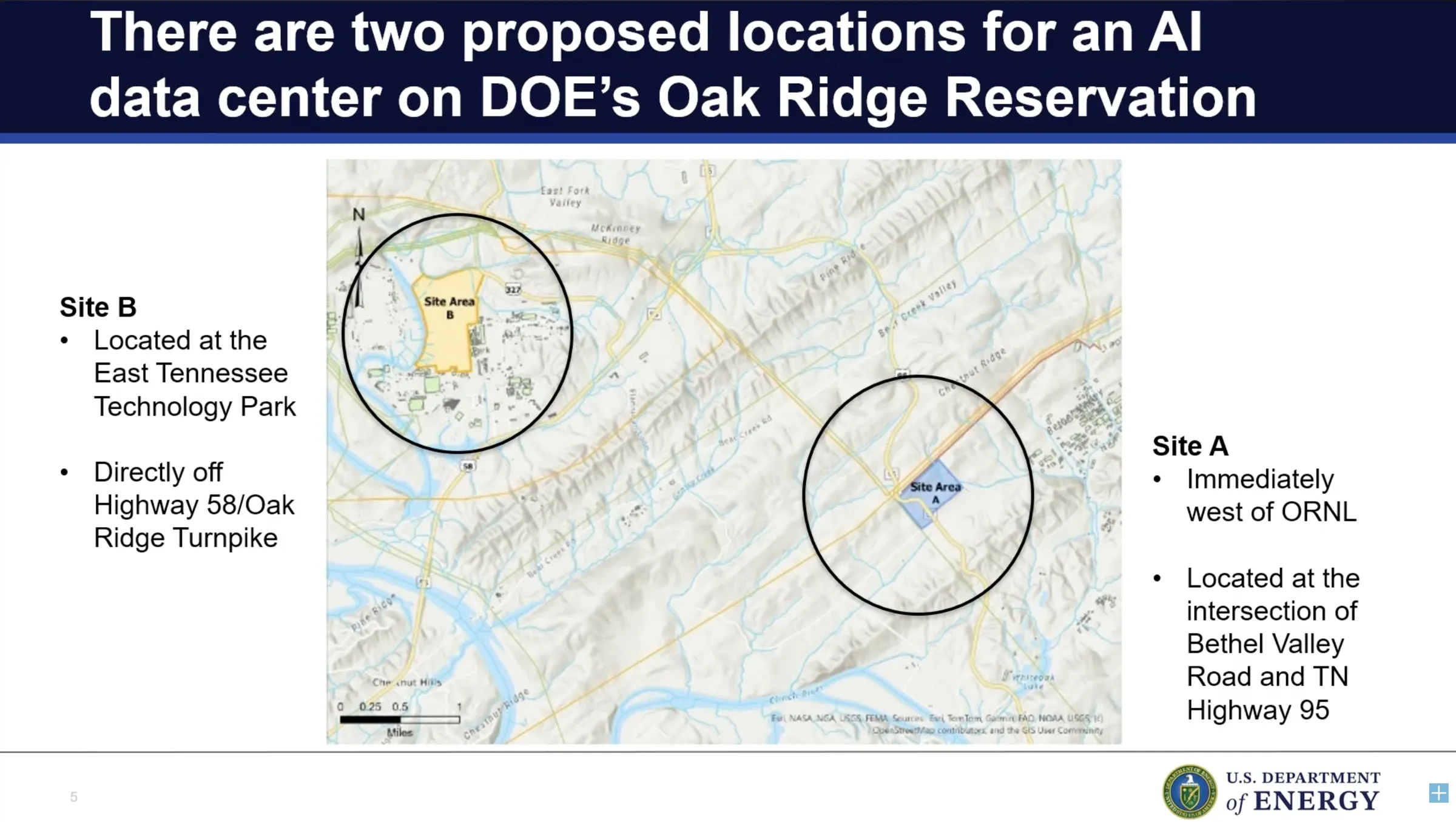
Still, Williams said DOE has not yet ruled out data centers on its Oak Ridge land.
“The Department has not yet decided on future missions for Oak Ridge and if that will include large scale data centers,” he said. “The Oak Ridge, Portsmouth, and Paducah sites all have attributes such as land, water, transmission capability, infrastructure, and transportation routes that make them well suited for AI, nuclear, power generation, or other missions in the future. The Department is making steady progress in actively remediating these sites to make land available for industrial, defense, or science reuse.”
Apart from focusing DOE’s resources elsewhere, Williams did not give reasons behind moving the focus for private data center leases away from Oak Ridge to Kentucky and Ohio.
Oak Ridge National Laboratory announced in February the creation of the Next Generation Data Centers Institute, staffed by materials scientists. cybersecurity and computer scientists experts who will examine, in part, ways to improve the energy efficiency and cooling systems of data centers.
“Artificial intelligence is transforming every part of our society, but its energy appetite is unlike anything we’ve seen before,” said ORNL Director Stephen Streiffer in a release announcing the institute. “The electricity required to power AI data centers is expected to double or triple in the coming decade, straining infrastructure that is already under pressure. ORNL is uniquely positioned to meet this challenge.”
Data centers have drawn criticism nationwide and in the Oak Ridge area, however, centering around their large power and water usage, affecting the environment utilities and local consumers. The Knoxville-based environmental group Southern Alliance for Clean Energy called for a national 18-month moratorium “to proactively define rules on transparency, pollution, cost, and risk before the concrete is poured,” although no such national moratorium is yet in effect. Locally, moratoriums are going into effect for Oak Ridge’s two counties, Anderson and Roane, both for two years. These bans, however, do not apply to Oak Ridge. The city’s planning and zoning ordinances are separate from those of the county.
Despite this opposition, the Trump Administration has voiced support for data centers. DOE originally promoted Oak Ridge in keeping with executive orders, Removing Barriers to American Leadership in Artificial Intelligence and Unleashing American Energy, “which leverage federal land assets to quickly deploy data centers and energy generation projects,” DOE stated.
“As one of the original Manhattan Project sites, Oak Ridge is now poised to play a role in what has been dubbed Manhattan Project 2.0 as the Department ushers in a golden era of American energy to fuel the AI race,” said DOE Acting Assistant Secretary for Environmental Management Joel Bradburne in a 2025 press release when DOE was still considering the site for data centers focusing on artificial intelligence.
The apparent shift comes despite a slough of announcements this year hailing the arrival of a “nuclear renaissance” in Oak Ridge, frequently touted as a way to provide the speculated electricity demand driven by data centers. The Tennessee Valley Authority is pursuing a small modular nuclear reactor at its Clinch River site, funded in part by the Department of Energy. TVA has cited data centers in its electricity demand projections.
SACE maintains many of these usage forecasts are overly speculative, and risk hurting ratepayers as well as the environment as utilities, specifically TVA, once again lean into fossil fuel infrastructure to meet the projected demand.