
Sustainability (499)
Children categories

Sustainable Development Goals (914)
The Sustainable Development Goals are a universal call to action to end poverty, protect the planet and improve the lives and prospects of everyone, everywhere. The seventeen Sustaiable Development Goals (SDG) were adopted by all UN Member States in 2015, as part of the 2030 Agenda for Sustainable Development which set out a 15-year plan to achieve the Goals.
Five years after the start of a series of localized disasters, new boat ramps lead paddlers to water in Big South Fork
Written by Thomas Fraser The Big South Fork on the Cumberland River as seen at Leatherwood Ford in March 2020 when it recorded a record height of 39 feet. One year later, it recorded a new record height of 41 feet. The flooding destroyed four boat ramps in the area, the park service has now rebuilt them all. Big South Fork is a very popular paddling destination. National Park Service
Big South Fork completes substantial repairs to four boat launches damaged in series of rain and windstorms
ONEIDA — Workers in Big South Fork National River and Recreation Area completed repairs to four popular boat launches damaged by significant generational flooding events over the past couple of years.
Park staff dismantled and rebuilt the boat launches at Blue Heron Mine-18, Brewster Bridge, Station Camp and Peters Bridge, all of which were severely damaged during flooding in March 2021 that arose after 8 inches of rain fell in and around Big South Fork. The Big South Fork of the Cumberland River reached 41 feet at Leatherwood Ford; three days prior it was at 7 feet.
The second-highest flow of the river since rain gauges were installed in the park in 1984 occurred just a year earlier in 2020 when the river hit 39 feet.
The park also experienced flooding in 2024, during which a man perished after he fell in a park waterway. Severe storms also damaged or destroyed multiple Big South Fork facilities and blocked roads and trails for weeks.
Big South Fork includes nearly 250 miles of rivers and streams and is a destination park for water recreation, and rock climbing.
Audubon Christmas bird tally hits 125 years and counting
Written by Holly Kays A pileated woodpecker is seen seeking dinner; it is a common denizen of winter Southern Appalachian forests and likely made many Christmas bird lists. Evan Kidd via Smokies Life
Citizen-led Audubon Christmas Bird Count tallies our feathered friends for yet another year
Holly Kays is the lead writer for Smokies Life.
GATLINBURG — Since its origin in 1900, the Christmas Bird Count has become a holiday fixture for ever-expanding numbers of birders across the globe, giving a valuable gift to generations of wildlife scientists — a massive trove of data on bird populations in the Western Hemisphere.
This annual avian census, set to commence for the 125th time, began in an era when many bird species were facing steep declines, especially waterfowl prized for their feathers. The Christmas Bird Count was the National Audubon Society’s answer to the traditional Christmas Side Hunt, a team competition that encouraged participants to kill as many furred and feathered creatures as possible in a single outing.
“The Christmas Bird Count really got started as an alternative to those kinds of hunting efforts,” said Curtis Smalling, executive director of Audubon North Carolina. “This year is the 125th annual Christmas Bird Count, and that makes it the longest-running community science project in North America.”
Anyone can participate in the CBC, regardless of their birding skill level, by joining one of the thousands of circles, each 15 miles in diameter, that comprise the event. The organizer of each circle chooses a day between December 14 and January 5 to conduct their count. On the appointed day, all participants in the circle have 24 hours in which to tally as many birds as they can. In addition to listing the individual species spotted, they also count the number of individual birds seen and participant hours logged.
The Great Smoky Mountains region includes circles in Gatlinburg, Cades Cove, Knoxville, Franklin, Highlands, Waynesville, Hot Springs and Asheville.
 A male (left) and female common merganser perch on a rock. Though this species may winter in coastal areas, it tends to prefer freshwater habitat and winters in the Smokies in small numbers. Warren Bielenberg via Smokies Life
TWRA warns of bird flu spikes throughout Tennessee; urges caution from hunters, farmers and bird watchers
Written by Lee Wilmot Even small backyard flocks, such as the one seen here in South Knox County, are susceptible to fatal avian influenza. The state of Tennessee issued guidelines and warnings as the number of bird flu outbreaks soars. Thomas Fraser/Hellbender Press
If you have birdfeeders at home, remove any dead birds you may encounter and stop feeding; minimize any poultry/wildlife interactions
Lee Wilmot is a TWRA information specialist. This story will be updated.
NASHVILLE — The Tennessee Wildlife Resources Agency is reminding hunters to remain vigilant and take appropriate precautions as reported cases of Highly Pathogenic Avian Influenza (HPAI) increase among wild birds, backyard domestic flocks and commercial poultry flocks in the Southeast. HPAI is highly contagious among bird populations and is known to be deadly for domestic fowl.
(California Gov. Gavin Newsom on Dec. 18 declared a state of emergency in California as cases in that state jump dramatically).
“Numerous states in the Mississippi Flyway are reporting HPAI detections that are leading to dead and dying birds, mainly snow geese,” said Jamie Feddersen, TWRA Migratory Gamebird Coordinator. “Tennessee is also finding ducks and geese with HPAI. Hunters should follow safety precautions when handling these birds.”
“Since March 2022, Tennessee has confirmed numerous cases of Highly Pathogenic Avian Influenza in wild birds, including ducks, Canada geese, vultures and a Bald Eagle,” said TWRA Wildlife and Forestry Chief Joe Benedict. “We urge homeowners and hunters to take precautions to prevent the spread of the disease in Tennessee and to protect wildlife and poultry populations.”
Learn about using your forest as a carbon sink

KNOXVILLE — The next installment of Conservation on Tap is set for 7 p.m. Jan. 8 at Albright Grove Brewing Company, 2924 Sutherland Ave., Knoxville.
Join forester Sean Bowers to learn about the Family Forest Carbon Program, a partnership between the American Forest Foundation and The Nature Conservancy. The program allows owners of small tracts of forest access to carbon markets, empowering them to improve the health and wellbeing of their forests and help tackle climate change.
All proceeds from Conservation on Tap benefit Discover Life in America.
Helene: After weeks of dredging, CSX receives stop-work order on Nolichucky Gorge railroad destroyed by tropical storm
Written by Anita Wadhwani Epic flooding from Tropical Storm Helene destroyed the CSX railroad bed along the length of the Nolichucky River Gorge near Erwin. TDEC and the U.S. Army Corps of Engineers this month ordered the transportation company to stop dredging materials from the river to repair its railroad line. Jonathan Mitchell for Hellbender Press
Company accused of illegally mining river rocks, sediment to shore up rail lines washed out by Helene
This story was originally published by Tennessee Lookout.
ERWIN — The U.S. Army Corps of Engineers and Tennessee environmental regulators ordered CSX Transportation to stop dredging the Nolichucky River Gorge for rocks and sediment being used to shore up a rail line washed away by Tropical Storm Helene.
In separate letters issued to the Fortune 500 company this month, the Corps and the Tennessee Department of Environment and Conservation (TDEC) warned, the company’s dredging was unauthorized — and noted CSX had continued dredging activities even after being put on notice last month by both agencies.
The company is prohibited from performing “any excavation or dredging of material from the Nolichucky River or its tributaries in both Tennessee and North Carolina, the Dec. 2 letter from the Corps said. CSX must “immediately cease and desist” its dredging, TDEC’s Dec. 6 letter said.
Dredging poses serious risks to the river’s aquatic life and increases the potential of downstream flooding in the future for communities that rely on the Nolichucky for outdoor recreation and the tourist dollars it brings in, a lawsuit filed by lawyers with the Southern Environmental Law Center said last month.
Meet the candidate: Eastern hellbenders finally in line for inclusion on Endangered Species List
Written by Melissa Clark The U.S. Fish and Wildlife Service seeks public comment on a proposal to place the eastern hellbender on the Endangered Species List. The hellbender seen here is part of an exhibit at an East Tennessee zoo. Chattanooga Zoo
USFWS seeks public comment on proposed listing of crucial indicator species throughout its known range; several populations in Smokies region
Melissa Clark is a U.S. Fish and Wildlife Service senior public affairs specialist.
The U.S. Fish and Wildlife Service announced Dec. 12 a proposal to list the eastern hellbender as an endangered species throughout its range under the Endangered Species Act. Eastern hellbenders are found in Alabama, Georgia, Illinois, Indiana, Kentucky, Maryland, Mississippi, Missouri, New York, North Carolina, Ohio, Pennsylvania, Tennessee, Virginia and West Virginia.
“The eastern hellbender is a unique salamander that plays a crucial role in maintaining healthy freshwater ecosystems,” said Service Midwest Regional Director Will Meeks. “As key indicators of stream and river health, hellbenders need protection that also will help support healthier ecosystems across their range.”
Historically, eastern hellbenders have been documented in 626 populations. Recent data indicate only 371 of these populations (59%) remain. Among the remaining populations, only 45 (12%) are stable, 108 (29%) have an unknown recruitment status, and 218 (59%) are in decline.
The eastern hellbender is one of two subspecies of hellbenders in the United States. The other subspecies, the Ozark hellbender, occurs in Missouri and Arkansas and was listed as an endangered species in 2011. In 2021, the Missouri distinct population segment of the eastern hellbender was listed as endangered.
She taught us to “fight with purpose, and love without constraint:” Nikki Giovanni, literary icon and civil rights activist, dies at 81 in Blacksburg
Written by Angela Dennis Renowned poet, educator and civil rights activist Nikki Giovanni died Dec. 9 at 81. Jeanine Fuller/Social media
“Knoxville, Tennessee”
I always like summer
best
you can eat fresh corn
from daddy's garden
and okra
and greens
and cabbage
and lots of
barbecue
and buttermilk
and homemade ice-cream
at the church picnic
and listen to
gospel music
outside
at the church
homecoming
and you go to the mountains with
your grandmother
and go barefooted
and be warm
all the time
not only when you go to bed
and sleep
— Nikki Giovanni
BLACKSBURG — Knoxville native Nikki Giovanni, a poet, civil rights legend and educator who empowered generations with her fearless words and unwavering advocacy for Black America, died on Dec. 9 at the age of 81 after her third cancer diagnosis.
“The acclaimed poet, Black Arts Movement icon whose poems of wit, wonder and wisdom were celebrated in children’s books, on keynote stages and television shows, and in more than two dozen bestselling poetry collections, died peacefully on December 9, 2024, with her life-long partner, Virginia [Ginney] Fowler, by her side,” said friend and author Renee Watson in a statement.
In 2023, Knoxville’s Beck Cultural Exchange Center unveiled an exhibit dedicated to Giovanni, featuring her complete book collection and personal memorabilia. The center, a cherished space for Giovanni, was a must-visit whenever she returned to her hometown.
“Nikki was a gift to the world, generously sharing her talents with everyone around her,” said Rev. Reneé Kesler, President of the Beck Cultural Exchange Center. She loved deeply and expressed that love in countless ways.”
Yolande Cornelia “Nikki” Giovanni was born on June 7, 1943, in the “Negro Wing” of Knoxville General Hospital to parents Yolande Cornelia Sr. and Jones “Gus” Giovanni. She graduated from Austin High School in 1961.
She enrolled at the historically Black Fisk University in Nashville in 1960. At Fisk, she joined the Writer’s Workshop, a space that fostered her creativity and connected her with other aspiring Black writers who later went on to become prominent Black literary figures such as Dudley Randall, Margaret Walker and Amiri Baraka.
“At Fisk, she found her voice — a voice that would go on to inspire the world to dream with courage, to fight with purpose and to love without constraint. Through her poetry, she wove stories of Black resilience, beauty and liberation. Her spirit is forever etched into the soul at Fisk, an eternal light guiding us toward justice, creativity and authenticity,” Fisk officials said in a statement.
Feds to restart “technical and design work” for Foothills Parkway extension
Written by Thomas Fraser
Conservation groups have cautioned against the zombie roadway between Wears Valley and Gatlinburg; EIS-level study uncertain
This story will be updated.
Concerns raised by the public over the decades range from impacts on domestic water supplies and endangered or threatened species to the fact the roadway might be a catalyst for excessive tourism infrastructure in Townsend and Wears Valley.
NOAA’s Teek and Tom bring fun and free science to classrooms and homes
Written by National Oceanic and Atmospheric Administration
It’s all about the ocean-weather-climate connection!
Join intrepid student explorer Teek from planet Queloz and National Oceanic and Atmospheric Administration (NOAA) climate scientist Tom Di Liberto as they explore planet Earth’s weather and climate. This five-part science series covers a range of scientific topics, including how the ocean influences weather and climate on Earth, and the technologies scientists use to gather information about our planet and its changing climate.
Each episode is supplemented by two lesson plans designed for students in the fourth through sixth grades — all of which are compiled in a single Educator’s Guide. Each lesson allows students to explore and investigate NOAA data, visualizations and content, allowing them to build knowledge of and skills associated with important Earth science concepts.
An understanding of how the Earth works as a system and how humans interact with the Earth is important for all inhabitants of our planet. Teek and Tom are a fun and engaging way to grow that understanding!
Teek and Tom: Educator’s Guide
The Teek and Tom Educator’s Guide includes 10 lesson plans — two supplementing each episode. The lessons allow students to build knowledge of and skills associated with important Earth science concepts. Through the exploration and investigation of NOAA data, visualizations, and content, the lessons support the videos in telling a cohesive story of key Earth systems, and how those systems impact each other.
Each lesson is aligned to the Next Generation Science Standards (NGSS), national standards for math, national standards for English and language arts, and the College, Career, and Civic Life (C3) Framework for Social Studies State Standards. These standards reinforce the interdisciplinary nature of ocean, weather and climate studies, and support the teaching of these topics. The lessons engage students in content that is locally relevant; and use the 5E model (Engage, Explore, Explain, Elaborate, Evaluate) to provide a structure for students to connect science ideas with their own experiences, and apply their learning to new contexts.
To access this high-caliber, free science lesson, download the educator’s guide.
Helene: Storm left devastation from Mountains to Sea
Written by Mark Barrett Water rose an estimated 15-18 feet on this side channel of North Fork of the Catawba River near Marion, N.C. Photos by Mark Barrett
Impromptu backcountry hike reveals extent of remote storm wreckage in WNC
Mark Barrett is an Asheville-based journalist. He reported for the New York Times at the height of Tropical Storm Helene.
MARION — I had a lot of chores to do Saturday but went hiking instead. I had read that the Mountains-to-Sea Trail was open from Woodlawn, N.C., a few miles north of Marion, east to the North Fork of the Catawba River so I decided to see what was left of the pedestrian bridge across the river after Helene.
I took a logging road part of the way there and before I reached the river I managed to make a wrong turn. Once I realized my mistake I decided to go cross country instead of retracing my steps since that would be shorter.
I walked into one of the scenes folks living in Western North Carolina are familiar with: Helene blew down two out of every three trees. Places like this make hiking a contact sport, and a slow and laborious one at that. Still, it was interesting to see.

After maybe half a mile of walking on, under and over downed trees, I made it into open woods and not far after that, to the spot where the bridge once stood. The only things visible were the abutments on either end and the pier, which had washed 50 to 100 yards downstream. Photos of the pier taken before Helene show it sitting on dry ground with an area behind it where it looks like water washed through during a flood. On my way back toward my car, I saw the main part of the bridge on the opposite side of the river a third of a mile or so downstream.
In search of hellbenders, biologists find mudpuppy love in North Georgia
Written by Thomas Floyd A mudpuppy mugs for the camera. A hellbender survey in North Georgia uncovered these rare denizens of Southern Appalachia. Tyler Troxel/Georgia Department of Natural Resources
Only three of the small water dogs have been documented in North Georgia section of Tennessee River drainage since 2011
Thomas Floyd is a wildlife biologist with the Wildlife Conservation Section of the Georgia Department of Natural Resources.
BLAIRSVILLE — Hellbender surveys in North Georgia turned up a welcome surprise this summer: one of the state’s few sightings of common mudpuppies.
Although these big freshwater salamanders also known as waterdogs range from New York to the Great Lakes and from southern Canada to the rivers of northern Mississippi, Alabama and Georgia, common mudpuppies are abundant in only parts of that realm. And in Georgia, they are rare.
The mid-August capture and release of three mudpuppies near Blairsville marked only the third time that Necturus maculosus has been documented in the state. The previous sightings were near Ringgold in 1987 and McCaysville in 2010.
While mudpuppies are found alongside eastern hellbenders throughout much of the hellbender’s range, it’s unclear why mudpuppies are so elusive or simply absent in many streams in Western North Carolina and Georgia.
 A Blairsville mudpuppy is seen on the right. On the left are ways to identify a common mudpuppy. Thomas Floyd/Georgia Department of Natural Resources
Since 2011, DNR surveys have recorded nearly 900 hellbenders across the Tennessee River drainage in North Georgia. But during that same time, and in what is the state's presumed distribution of mudpuppies, only three waterdogs have been seen.
Helene: ORNL forest disturbance tool tracks devastation wrought by wind
Written by Stephanie G. Seay The ForWarn vegetation tracking tool shows areas of red where extreme disturbance to the forest canopy occurred in Western North Carolina, East Tennessee and southern Virginia as a result of Hurricane Helene in late September 2024. Jitendra Kumar/ORNL, U.S. Dept. of Energy
Information will help timber gleaning, fire-hazard mitigation
Stephanie Seay is a senior science writer and communications specialist at Oak Ridge National Laboratory.
OAK RIDGE — A visualization tool that tracks changes to the nation’s forests in near-real time is helping resource managers pinpoint areas with the most damage from Hurricane Helene in the Southeast.
The ForWarn visualization tool was co-developed by Oak Ridge National Laboratory with the U.S. Forest Service. The tool captures and analyzes satellite imagery to track impacts such as storms, wildfire and pests on forests across the nation.
When staff with the Forest Service’s Eastern Forest Environmental Threat Assessment Center in Asheville, North Carolina, were unable to work in the immediate aftermath of Helene due to utility outages, the ORNL-hosted ForWarn system continued monitoring the storm’s impact and providing reports. ForWarn indicated areas of severe disturbance to the forest canopy that were later confirmed by aerial photography.
“ForWarn helps quickly identify areas that may need remediation such as timber harvesting or prescribed burns as piles of felled trees dry out and potentially pose wildfire hazards,” said ORNL’s Jitendra Kumar.
Gear up/look out: Deer hunting shot off Saturday
Written by Tennessee Wildlife Resources Agency
KNOXVILLE — Tennessee’s 2024-25 statewide gun hunting season for deer opens Saturday, Nov. 23. The season traditionally opens each year on the Saturday prior to Thanksgiving. During gun season, sportsmen may also use muzzleloaders or archery equipment.
The statewide bag limit for antlered bucks is two. No more than one antlered deer may be taken per day, not to exceed two for the season. In Units 1, 2 and 3 there is an antlerless bag limit of three per day, and a limit of two antlerless for this season in Units 4, 5 and 6. The bag limit may only be exceeded as part of the Earn-A-Buck program or as replacement buck in a CWD positive county.
During season setting, new hunting units were implemented for this season. Hunters should refer to the 2024-25 Tennessee Fishing, Hunting and Trapping Guide for specific information about their hunting unit and complete license requirements.
Anyone born on or after Jan. 1, 1969, is required to carry proof of satisfactory completion of a hunter education class or be in possession of the Apprentice Hunter Education Permit (along with other required licenses) while hunting any species in Tennessee. Hunter education can be completed online for free along with in person options offered by TWRA.
The statewide deer hunting season will continue through Jan. 5, 2025. The second Young Sportsman Hunt is Jan. 11-12.
Park service opens trail to forever in Great Smokies
Written by Dave Barak A trail crew takes a breather after laboring on the Ramsey Cascades Trail in Great Smoky Mountains National Park. Crew members and park officials formally opened the rehabilitated trail this week after three years of work. National Park Service
Radically enhanced Ramsey Cascades Trail leads to national park’s highest waterfall
Dave Barak is a public affairs specialist with the National Park Service.
GATLINBURG — In collaboration with Friends of the Smokies, the National Park Service (NPS) completed a three-year restoration of the Ramsey Cascades Trail in Great Smoky Mountains National Park. Located in the Greenbrier area, this popular trail ascends through beautiful hardwood forests to the 105-foot Ramsey Cascades, the tallest waterfall in the park. The trail is now open seven days a week following an extensive reconstruction and rehabilitation.
The NPS and Friends of the Smokies celebrated the milestone at the Ramsey Cascades trailhead. Following remarks and a ribbon-cutting, several participants hiked the newly restored trail together.
Improvements to the Ramsey Cascades Trail include:
Throughout this rehabilitation, the NPS restored Ramsey Cascades — with the original trail design in mind — in a way that blends in with the natural landscape. Trail crew members used natural materials and hand tools and transported most tools and equipment by hand or pack mule. A helicopter delivered several loads to five drop sites that the mule team could not access. The trail crew used 1,200 black locust logs and 760,000 pounds of rock crush for fill for this rehabilitation.
 Crews had to carry many materials and tools to the site by hand or mule. National Park Service
“Trails Forever is an excellent example of the collaborative partnership between Great Smoky Mountains National Park and Friends of the Smokies,” said Boone Vandzura, Acting Deputy Superintendent. “Together we’ve preserved and rehabilitated trails that enhance the recreational experience of millions of visitors.”
In war-torn Ukraine, nature refills reservoir destroyed by Russia
Written by Ruchi Kumar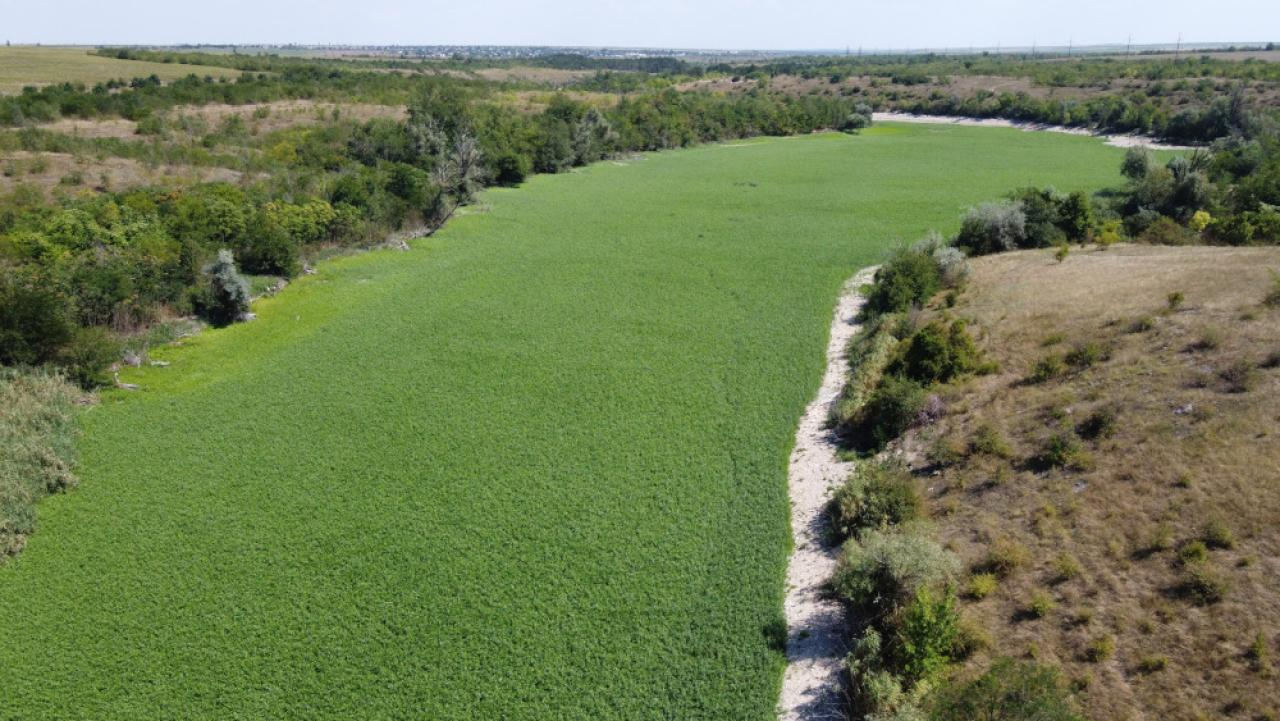 A range of vegetation has moved into the former Kakhovka reservoir in Ukraine. Russian occupying forces destroyed the dam along the Dnieper River in June 2023. Photos by Serhiiy Skoryk
Russia’s bombing of Kakhovka Dam in 2023 killed hundreds of people and tens of thousands of animals, but it also provided a potential ecological reset.
This story was originally published by The Revelator.
KYIV — In the early hours of June 6, 2023, two large explosions reverberated across cities and small towns located on the banks of the Dnieper River in southern Ukraine. The Russian military had reportedly set off multiple bombs, destroying the three-kilometer-long Kakhovka Dam and draining its massive reservoir into nearby settlements.
Water from the dam flooded the plains, killing hundreds of civilians and countless livestock, destroying farms, and displacing the residents of more than 37,000 homes.
The bombing made headlines around the world. It’s the long-term impact of the attack on the local biodiversity, however, that has scientists and experts concerned. In the weeks following the explosion, researchers from Ukrainian ministries and independent organizations carried out several assessments as best they could to the backdrop of the war.
They found that the attack had flooded about 60,000 hectares (230 square miles) of forest in at least four national parks, threatening an estimated population of 20,000 animals and 10,000 birds.
 Serhiiy Skoryk, a national park director, is seen with landmines that are typical of those that have literally flooded the conflict zone during the Russian occupation of parts of Ukraine. These mines and other hazards complicate efforts to gauge the impact of the Russian invasion on Ukraine’s unique natural environment.
- russian ukraine conflict
- russian ukraine war
- ukraine war
- ukraine reservoir
- war and nature
- war effects on environment
- war pollution ukraine
- war affects on environment
- the revelator
- kakhovka dam
- dnieper river
- rewilding
- nature reclaiming reservoirs
- examples of nature reclaiming reservoirs
- legacy landmines
- landmine dangers
More...
A long, sad tale of when coal ash filled a valley so low
Written by Ray Zimmerman In the early morning hours of Dec. 22, 2008, the earthen wall of a containment pond at Tennessee’s Kingston Fossil Plant gave way. The breach released 1.3 million cubic meters (1.7 cubic yards) of sludge, infiltrating a nearby river and damaging dozens of homes. NASA Earth Observatory
Journalist’s book offers deep sweep of 2008 coal-ash disaster at TVA’s Kingston coal plant
CHATTANOOGA — Jared Sullivan’s book, Valley So Low, is “A courtroom drama about the victims of one of the largest environmental disasters in US history — and the country lawyer who challenged the notion that, in America, justice can be bought.” Those words from the publisher’s dust jacket sum up the story, but the pathos of workers, certain that they got sick on the job, and the lawyer’s struggle against a well-funded corporate defense, is in the details.
Most residents of the Tennessee Valley remember the 2008 disaster when a wall of a coal ash slurry rushed out of the Kingston Steam Plant, flooding the Emory River and inundating 300 acres of the surrounding countryside.
Sullivan offered insight into the story to an audience in Chattanooga in October. When workers fell ill after the cleanup, local personal injury lawyer Jim Scott challenged Jacob’s Engineering, a private company the Tennessee Valley Authority contracted to manage the cleanup. Scott was the only lawyer willing to take their case, according to Sullivan.
- jared sullivan
- kingston coal ash spill
- kingston coal ash spill book
- 2008 coal ash disaster
- coal ash cleanup
- coal ash spill
- coal ash contamination
- coal fly ash slurry
- valley so low
- valley so low review
- ray zimmerman
- chattanooga nature events
- tennessee valley authority
- is coal ash storage unsafe
- coal ash book
- environmental journalist
- environmental journalism
Red-cockaded woodpecker gets new lease on wild life
Written by Georgia Department of Natural Resources A red-cockaded woodpecker in flight. The U.S. Fish and Wildlife Service announced last month the bird had been removed from the Endangered Species List. Martjan Lammertink/USFS
Staccato voice of Southern woodlands removed from Endangered Species List
ATLANTA — Life is looking up for red-cockaded woodpeckers.
These perky, family-focused woodpeckers of mature Southeastern pinelands — they’re the nation’s only woodpecker that excavates cavities in living pines — had been federally listed as endangered for 50 years. Yet late last month, the U.S. Fish and Wildlife Service downlisted them to threatened.
Their recovery from an estimated 1,470 family groups in the 1970s to about 7,800 groups today from Virginia to Texas reflects decades of work by government agencies, nonprofits and private landowners.
Georgia mirrors that outlook and effort. The number of red-cockaded woodpecker family groups here “is now well north of 1,500,” said Joe Burnam, lead Department of Natural Resources biologist for the species.
The success story ranges from military lands like Fort Stewart, where controlled burns and “recruitment” clusters of artificial nest cavities inserted in trees are helping the population grow, to southwest Georgia quail properties enrolled in Safe Harbor, part of a U.S.-first habitat conservation plan that DNR developed in 1999 for the woodpeckers and private landowners.
Burnam said the downlisting keeps federal protections in place and will not affect DNR conservation practices in the state. “We’ll continue to do what we’ve been doing … managing for the birds (and) their habitat.”
Habitat loss and degradation, a combo that landed the woodpeckers on the Endangered Species Act list, remain the leading threats. For example, Hurricane Helene wiped out over 40 percent of the nest cavity trees at Moody Forest Wildlife Management Area and Natural Area near Baxley.
But new cavity inserts have already been chainsawed into pines, and others will be added, Burnam said.
Helene: A month after epic flooding, Smokies still reeling from storm effects
Written by Holly Kays The Hiram Caldwell House looks out over a road rendered impassable following major flooding on Rough Fork Creek. Cataloochee Valley is closed until further notice. National Park Service
Damage to park infrastructure widespread on North Carolina side of Great Smoky Mountains National Park
Holly Kays is the lead writer for Smokies Life.
GATLINBURG — As Hurricane Helene gathered strength in the southern Gulf of Mexico, it seemed likely Great Smoky Mountains National Park would take a direct hit. The storm was a category 4 before slamming Florida’s Gulf Coast; then it headed north toward the Smokies.
But its course shifted east. Helene and its predecessor storm dropped unfathomable amounts of rain across Southern Appalachia — many places received well over a dozen inches in a matter of days, with some locations recording two dozen or more. The storm’s severity was unprecedented in the region, causing flash floods and landslides that have so far claimed at least 95 lives in North Carolina alone. Asheville, where extreme flooding destroyed entire neighborhoods and decimated the water system, logged more than 14 inches between September 24 and September 28.
Most of the park fell far enough west of Helene’s path to escape with only minor flooding, but its extreme eastern region — Cataloochee, Balsam Mountain, Big Creek — was inundated. Record-setting rains tore out trails and roads and damaged historic buildings, leading the park to close these areas until further notice.
 Cataloochee Valley is closed until further notice after flooding from Rough Creek Fork rendered Upper Cataloochee Valley Road impassable. National Park Service
Nukes hit Oak Ridge airport: Plans on hold in favor of private science enterprise
Written by Ben Pounds Illustrated photo from a presentation on the Oak Ridge Airport project to Roane County officials at the Roane County Courthouse in Kingston on Thursday, Dec. 7, 2017 soon after the state appropriated $15 million for use toward the now-paused airport project. Roane County via Oak Ridge Today
City: Airport ‘paused’ because of nearby planned uranium-enrichment facility
OAK RIDGE — The city paused its long-simmering and controversial project to build a general aviation airport in the western part of Oak Ridge.
Oak Ridge government announced it paused the plan to build the airport in part of East Tennessee Technology Park because another nearby project is going forward: Orano USA’s Project Ike. Orano announced its plans for that project, a large uranium enrichment facility, Wednesday, Sept. 4; the city of Oak Ridge announced its pause the following week, Wednesday Sept. 11.
The city stated it wanted to “re-evaluate the proposed location” for the airport due to the Orano plan. City communications specialist Lauren Gray declined to name any other locations the city might be considering, saying plans weren’t that definite yet.
(Hellbender Press won a first-place award from the East Tennessee Chapter of the Society of Professional Journalists for its previous coverage of the proposed Oak Ridge airport).