
Displaying items by tag: va tech college of natural resources and environment
Helene: $9m grant to fund assessment of storm impacts on forests and streams
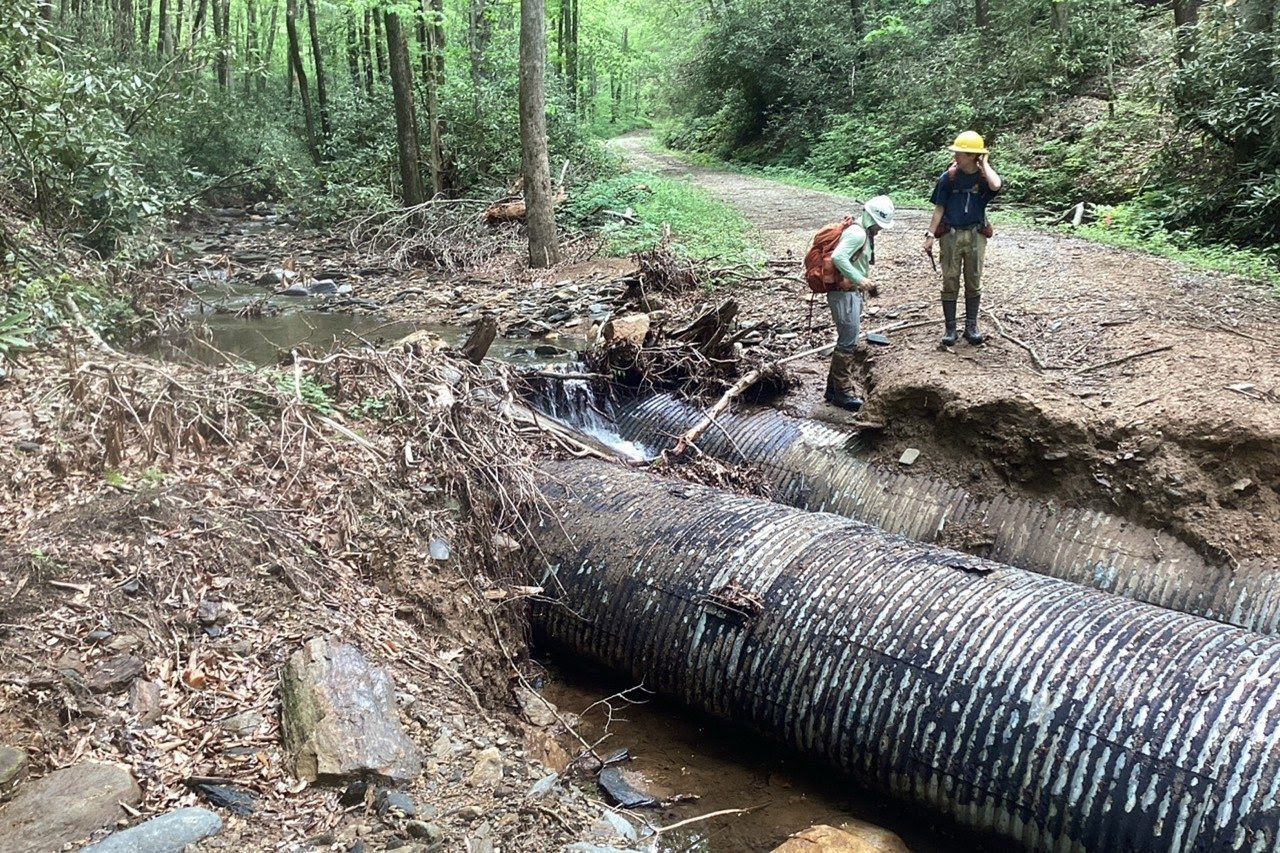 In May, researchers assessed the damage to a road and the stream than flowed within the culverts that resulted from flooding caused by Hurricane Helene. Colin Krause/USDA Forest Service.
Survey work will span Southern Appalachian forests devastated by historic 2024 hurricane, floods
BLACKSBURG — Virginia Tech and its Department of Fish and Wildlife Conservation, in partnership with the U.S. Department of Agriculture’s Forest Service Southern Research Station, received an $8.8 million grant to address environmental impacts from Hurricane Helene in the Southern Appalachians.
The initiative will be carried out through the Center for Aquatic Technology Transfer, a Forest Service office in Blacksburg that focuses on aquatic ecosystem science and management in national forests.
Virginia Tech will lead the human resources component, hiring and training technicians and crew leaders to conduct fieldwork. With the ability to call on current graduate students as well as connections to alumni with experience conducting analysis in a forest environment, the university can rapidly contract 20 employees to form teams and begin critical data collection in early 2026.
The benefit to the university comes in the experience students receive in providing this vital field research.
- va tech college of natural resources and environment
- va tech department of fish and wildlife conservation
- hurricane helene
- hurricane helen environmental impacts
- usda
- us forest service
- forest service southern research station
- center for aquatic technology transfer
- southern appalachian national forests
Researchers use environmental justice questions to reveal geographic biases in ChatGPT
 A U.S. map shows counties where residents could (blue) or could not (pink) receive local-specific information about environmental justice issues. Photo courtesy of Junghwan Kim via Virginia Tech.
Key findings indicate limitations of AI, suggest improvements
David Fleming is a communications specialist at Virginia Tech.
BLACKSBURG — Virginia Tech researchers have discovered limitations in ChatGPT’s capacity to provide location-specific information about environmental justice issues. Their findings, published in the journal Telematics and Informatics, suggest the potential for geographic biases existing in current generative artificial intelligence (AI) models.
ChatGPT is a large-language model developed by OpenAI Inc., an artificial intelligence research organization. ChatGPT is designed to understand questions and generate text responses based on requests from users. The technology has a wide range of applications from content creation and information gathering to data analysis and language translation.
A county-by-county overview
“As a geographer and geospatial data scientist, generative AI is a tool with powerful potential,” said Assistant Professor Junghwan Kim of the College of Natural Resources and Environment. “At the same time, we need to investigate the limitations of the technology to ensure that future developers recognize the possibilities of biases. That was the driving motivation of this research.”
Utilizing a list of the 3,108 counties in the contiguous United States, the research group asked the ChatGPT interface to answer a prompt asking about the environmental justice issues in each county. The researchers selected environmental justice as a topic to expand the range of questions typically used to test the performance of generative AI tools. Asking questions by county allowed the researchers to measure ChatGPT responses against sociodemographic considerations such as population density and median household income.