
Displaying items by tag: virginia tech college of natural resources and environment
Attention scientists: The public wants to know why you do what you do
 (From left) Dara Wald, associate professor, and Shumaila Bhatti, postdoctoral fellow, both in the School of Public and International Affairs. Photos courtesy of Dara Wald and Shumaila Bhatti.
In public perception of science validity, one big question: What's your motivation?
BLACKSBURG — A new study from Virginia Tech found that scientists’ credibility often hinges on their perceived motivations.
“Our study finds that perceptions of scientists’ motivation to serve the public good are the strongest predictor of whether Americans trust them, accept their information as credible, and support science-based policies,” said Dara Wald, associate professor in environmental policy and planning.
Published in Nature: Humanities and Social Sciences Communications, postdoctoral fellow Shumaila Bhatti and Associate Professor Dara M. Wald, both in the School of Public and International Affairs, identified five audience “classes” based on their perceptions of scientists’ credibility: enthusiasts, optimists, moderates, skeptics, and estranged. Researchers examined each group’s likelihood of adhering to recommendations from scientists, how they were influenced by politically controversial and non-controversial topics, and their underlying demographics.
According to the researchers, the work highlights a communication gap between how scientists often view credibility – expertise – and how the public perceives it – motivations — as well as many scientists lack training in communicating their personal motivations.
Nature fixes bald spots
 Geoscientist Sean Bemis, undergraduate student Madeleine Kronebusch, and Dhari Alharbi '22, who was a student at the time, review data collected by their ground-penetrating radar system. Photo courtesy of Sean Bemis
Virginia Tech scientists study how vegetation helps create soil on bare rock outcrops
Lon Wagner is senior director of communications and marketing in the Virginia Tech College of Science.
BLACKSBURG — In the forests of the southeastern United States, dense tree cover dominates most landscapes. That’s why the Appalachian Trail is sometimes nicknamed “The Green Tunnel.”
But avid hikers know that often in the Southeast, they’ll emerge from the green tunnel.
“When you walk out of the forest onto the rock, the contrast is immediate,” said Sean Bemis, a geoscientist and lead author of a study that uses these unique outcroppings as a natural laboratory to examine fundamental connections between rock weathering and vegetation. “You are standing on solid rock and you wonder where did all the trees go?”
Because of the lack of vegetation, these outcroppings are known as “balds.” But on geologic time scales, these balds have not always been devoid of vegetation. When bedrock is stripped of soil, it presents an extreme environment — hard, dry, and nutrient-poor — yet plants eventually take root. The study, published in the Journal of Geophysical Research-Earth Surface, reveals how this process unfolds during the earliest stages of what scientists call the critical zone: the life-supporting system of the Earth’s surface extending from bedrock to the tops of trees.
VT researchers: Exotic species are destroying forest seed systems
 Researchers study seeds at a collection site to see how data from 120 islands helps shape the bigger picture of seed dispersal. Haldre Rogers
Introduced species are changing how seeds move on islands, global study shows
Max Esterhuizen is the Virginia Tech College of Natural Resources and Environment director of communications and marketing.
BLACKSBURG — When birds, bats, and reptiles eat fruit, they help keep forests healthy by carrying seeds away from parent trees. On islands around the world the balance of which animals eat fruit and whether those animals disperse or destroy seeds has shifted dramatically.
A new study published Oct. 7 in the Proceedings of the National Academy of Sciences found that species introductions, more than extinctions, are reshaping this ecological process across 120 islands worldwide. The changes matter because seed dispersal drives forest regeneration, plant diversity, and long-term ecosystem health.
Virginia Tech ecologist Haldre Rogers, associate professor in the College of Natural Resources and Environment and the Department of Fish and Wildlife Conservation, was part of the international research team. Rogers contributed data from the Mariana Islands, a region where invasive brown tree snakes have wiped out most native forest birds. On Guam, the loss of birds and fruit bats has nearly erased natural seed dispersal, creating one of the most extreme examples anywhere.
According to the study, large-bodied flying animals that once dispersed seeds are being lost, while many of the newcomers are mammals that eat fruit but destroy the seeds.
In Virginia, Master Naturalists celebrate 20 years of stewardship and community
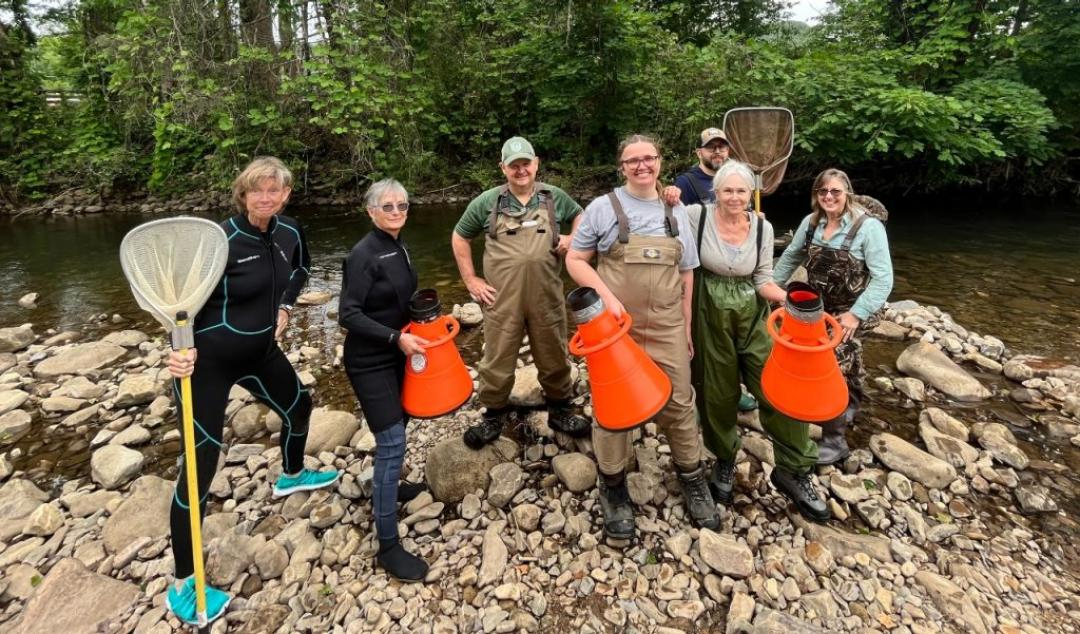
Volunteers in the Holston Rivers Chapter of the Virginia Master Naturalists learned about freshwater mussels and other aquatic organisms at an event where they were in the water, examining the natural habitats. Monica Hoel
Become a master of your domain; courses available in ET and WNC
BLACKSBURG — Two decades after its start, the Virginia Master Naturalist program continues to empower volunteers to protect and enhance the state’s natural resources.
Launched in 2005 as part of a growing national movement, the Virginia Master Naturalist program trains residents in ecology, wildlife, and environmental stewardship. Operated by Virginia Cooperative Extension and housed in the College of Natural Resources and Environment at Virginia Tech, the program has grown to 30 chapters across the commonwealth.
“The program emerged from a national push to establish Master Naturalist initiatives in every state,” said Michelle Prysby, the program's director and senior Extension specialist. “A framework was created in 2004 by five state agencies, and Virginia Tech was selected to lead the program.”
In East Tennessee, at least two Master Naturalist training programs are available; there are also several naturalist programs in Western North Carolina.
- southeastern master naturalist programs
- what can i learn as a master naturalist
- knoxville master naturalist classes
- virginia tech college of natural resources and environment
- western north carolina master naturalist classes
- holston rivers chapter of the virginia master naturalists
- how can i learn about nature
Fish on: First-time study links recreational fishing and nutrition
 A new paper reveals the important role that inland fisheries play in providing affordable nutrition around the world. Illustration courtesy of Lakshita Dey via Virginia Tech
Under-reporting of economics of sustenance fishing is a social justice issue
David Fleming is a Virginia Tech writer and communications specialist.
BLACKSBURG — It is a sight of summer: Along the banks of rivers and streams throughout the Southeast, recreational fishers will cast lines into the water, hoping that a fish will take the bait. In urban towns and cities such as Roanoke or Charlottesville, the same lines dangle from bridges or freshwater wharfs.
All of these activities are currently catagorized as “recreational fishing,” but for many fishers in the U.S. and around the world, the act of fishing in freshwater is not a leisurely pursuit but a way to provide critical sustenance and nutrition for individuals, families and communities.
An expansive new paper, co-authored by Virginia Tech Assistant Professor Elizabeth Nyboer of the College of Natural Resources and Environment and published in the journal Nature Food, reveals the underrecognized extent that inland recreational fisheries provide food and nutrition to people as well as offers insight on their vulnerability to future climate challenges.
- national climate adaptation center
- freshwater fisheries
- value of recreational fishing
- nutrients from fish
- sustenance fishing
- provisioning fishing
- virginia tech
- virginia tech college of natural resources and environment
- elizabeth nyboer
- usgs
- nature food journal
- holly embke
- social justice
- social justice fishing
- recreational fishing
- zero hunger sustainable development goal
- economic importance of recreational fishing
- inland fisheries
Stripes and spots: A tale of two Southern Appalachian skunks
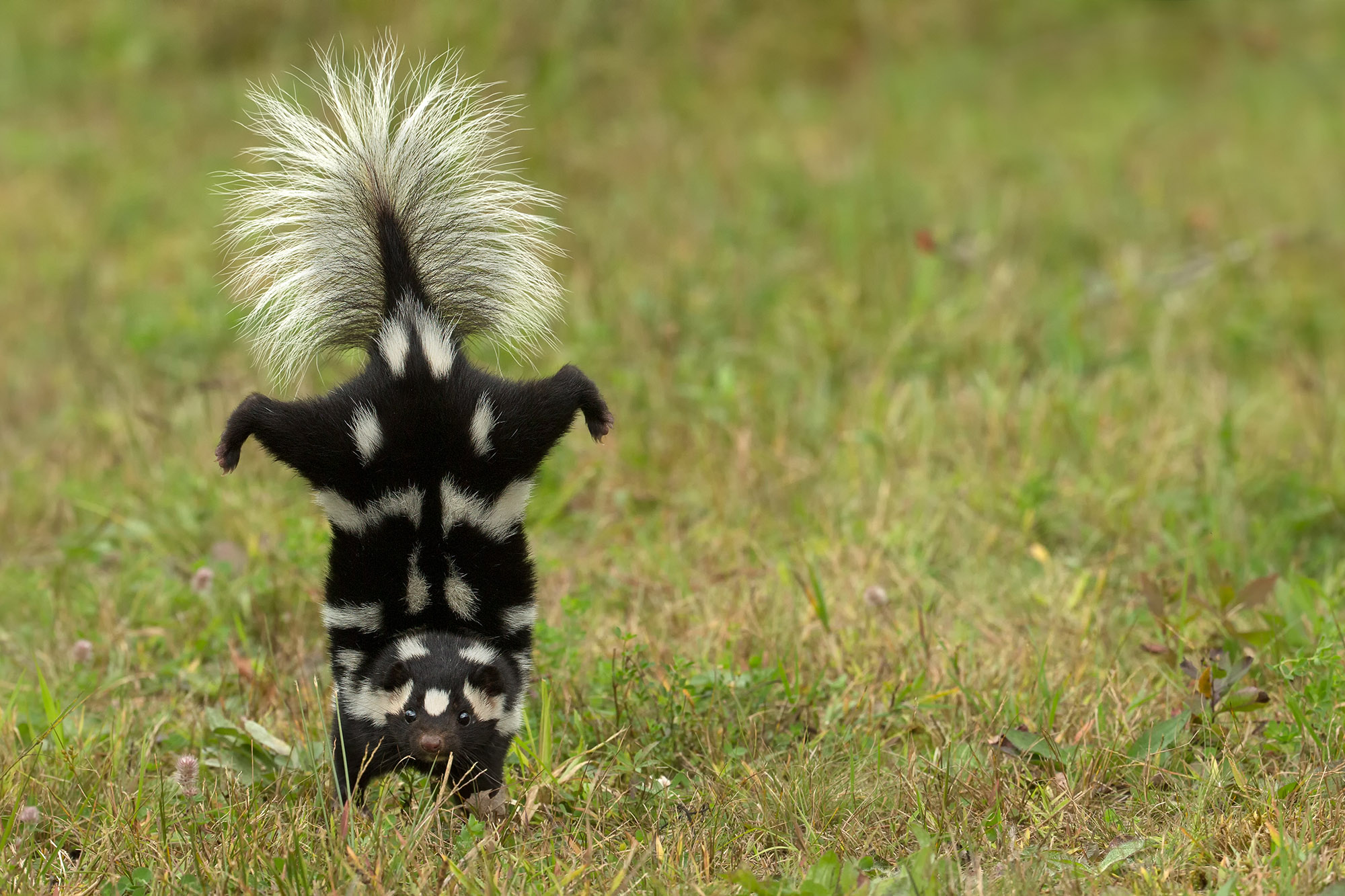 An eastern spotted skunk is seen in its signature defensive handstand. If the stance doesn’t deter predators it will let loose a caustic and malodorous spray akin to mace. Agnieszka Bacal via Virginia Department of Wildlife Resources
Striped skunks thrive as spotted cousins decline
This story was originally published by The Appalachian Voice.
BOONE — A characteristic white stripe on a black pelt is an instant warning to tread gently.
Nature’s stink bomb, the striped skunk (Mephitis mephitis) carries this distinctive mark on its back. But Appalachia has a second variety of this master of malodor, marked instead by a blotchy pattern of black and white fur.
The eastern spotted skunk (Spilogale putorius), was not always as rare as it is today. Decades ago, it was relatively common for trappers to catch the polecat, as it’s also known, for its pelt. But spotted skunk populations crashed between 1940 and 1970, according to a landmark paper from the University of Missouri looking at harvest data from trappers. By the 1980s, the study found, harvest numbers had plummeted by 99 percent, reflecting a steep decline in the skunk’s population.
Meanwhile, the spotted skunk’s striped cousin has thrived throughout the United States. So why have their populations diverged so drastically?
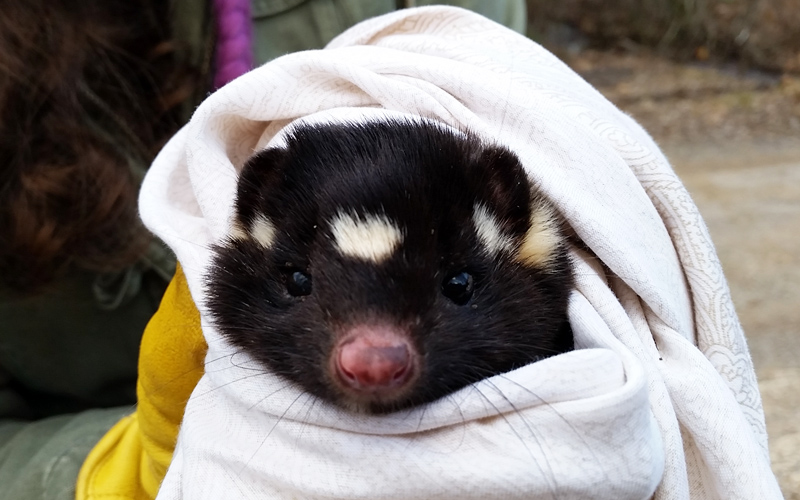 A spotted skunk trapped as part of Emily Thorne’s Virginia Tech study of the animals. Emily Thorne
Virginia Tech sleuths are investigating mysterious hellbender disappearances
 Virginia Tech Professor Bill Hopkins preparing to gently return a hellbender to its underwater home in a Virginia stream after taking measurements. Lara Hopkins/Virginia Tech
One clue: They eat their own in deforested stream corridors
Mike Allen is a media relations officer for Virginia Tech.
BLACKSBURG — The gigantic salamanders known as hellbenders, once the apex predators of many freshwater streams, have been in decline for decades, their population constantly shrinking. No one knew why. William Hopkins, professor in the Department of Fish and Wildlife Conservation and director of the Global Change Center at Virginia Tech, suspected the hellbenders’ plight had connections with environmental changes engineered by humans.
Hellbender males select nesting sites on stream bottoms and guard the eggs laid there by females — and occasionally the salamander dads snack on the eggs, consuming them before they ever get to hatch. A study that Hopkins led, conducted through eight years of snorkeling in ice-cold Southwest Virginia streams and published in The American Naturalist, determined that in deforested areas, hellbender fathers are far more likely to eat their entire brood than in areas that still have lush foliage.
This behavior, known as filial cannibalism, probably evolved as a survival tactic for enduring harsh conditions. Prior to Hopkins’ results, scientists were not aware that hellbenders’ filial cannibalism drastically increased in cleared lands, actively speeding the species out of existence.