
Feedbag (218)
Children categories
OAK RIDGE — The Center for Bioenergy Innovation has been renewed by the Department of Energy as one of four bioenergy research centers across the nation to advance robust, economical production of plant-based fuels and chemicals. CBI, led by Oak Ridge National Laboratory, is focused on the development of nonfood biomass crops and specialty processes for the production of sustainable jet fuel to help decarbonize the aviation sector.
The DOE announcement provides $590 million to the centers over the next five years. Initial funding for the four centers will total $110 million for Fiscal Year 2023. Outyear funding will total up to $120 million per year over the following four years, contingent on availability of funds.
“To meet our future energy needs, we will need versatile renewables like bioenergy as a low-carbon fuel for some parts of our transportation sector,” said U.S. Secretary of Energy Jennifer M. Granholm. “Continuing to fund the important scientific work conducted at our Bioenergy Research Centers is critical to ensuring these sustainable resources can be an efficient and affordable part of our clean energy future.”
— Sara C. Shoemaker, Oak Ridge National Laboratory
Knox County mayor honors women leaders in STEAM all month
Written by Thomas FraserKNOXVILLE — Knox County Mayor Glenn Jacobs is observing Women’s History Month throughout March by sharing videos each Wednesday highlighting time spent in different Knox County Schools’ Science, Technology, Engineering, Art and Math (STEAM) classrooms taught by female teachers.
The March 15 video features a visit with South Doyle High School STEM/Computer Science and 2022 KCS Secondary Teacher of the Year Katie DeVinney who was teaching a class on the principles of advanced manufacturing and practical design.
“I hope out of courses like this, that young women are able to see the opportunities available in sectors of the economy like advanced manufacturing and hopefully pursue those,” Jacobs said in a press release.
DeVinney is a 10-year educator who began her career as a foreign language instructor but was inspired by her husband who started the Robotics program at South Doyle High School, to switch paths.
“I just love it. It’s so much fun to see the excitement in kids when they get to take something that they designed on this computer and then hold it in the real world. It’s the coolest process I have ever seen so that’s kind of why I do it.” DeVinney said.
Mayor Jacobs said celebrating women in STEAM is important for young girls because it shows them that women can succeed in technical fields — industry typically driven by men.
The mayor has already shared his visit with Hardin Valley Elementary STEM Educators Jessica Everitt and Jana Yra and his visit with West Valley Middle science teacher Bethany Saunders.
Later this month, he will share visits with Gibbs Middle School Art Teacher Dorothy Verbick and STEM Teacher Lauren Downs; as well as Karns Middle School Math Teacher Rebecca Layton.
— Knox County Mayors Office
Updated: Her Oak Ridge story is finally told in a federal space
Written by Thomas Fraser
OAK RIDGE — For the month of April 2023, the exhibition can bee seen, Thursdays and Fridays from 10 a.m. to 2 p.m. and Saturdays from 10 a.m. to 3 p.m., at the Oak Ridge History Museum, which is housed in the Midtown Community Center at 102 Robertsville Road, Oak Ridge, TN. That building itself is a significant landmark of Oak Ridge history. Constructed 1944-45, it has been used as a bathhouse and laundry, a hangout for students, a senior center, the Oak Ridge Convention & Visitors Bureau, and office of the Oak Ridge Heritage and Preservation Association. Many long-term Oak Ridgers refer to it simply as the ”Wildcat Den,” harking back to the time it was home base of the high school’s football team, the Oak Ridge Wildcats that were national champions in 1958.
NORRIS — The W. G. Lenoir Museum in Norris Dam State Park will be hosting “HerStory: A Photography Exhibition of Women in the Secret City.” The exhibit will open on March 1, and be on display through the month in honor of Women’s History Month.
Constructed by the Civilian Conservation Corps (CCC) and opened in May 1936, Norris Dam State Park was managed by the Tennessee Valley Authority for 18 years prior to becoming a Tennessee State Park in 1953. Oak Ridge’s selection for the Manhattan Project was, in part, due to rural electrification that Norris Dam accomplished.
During the early 1940s, the park was closed to the public and the CCC vacation cottages winterized to house Manhattan Project workers. Later serving as a popular recreation destination for the growing government town, Norris Dam State Park continues to attract visitors from throughout the region. The construction of Norris Dam and Oak Ridge necessitated the relocation of countless families of the Clinch River valley by the federal government. These historical events connect these parks, and this new partnership will strive to tell the full stories of these places.
From janitors to homemakers and chemists, the women of the Manhattan Project worked hard and talked little. During WWII, Oak Ridge was a government town of 70,000 workers; primarily women who lived in a camp-like environment of barbed wire, security checkpoints, and code words. Workers were fingerprinted, interviewed, assigned a job, and given a clearance badge. Housing was limited and cramped and often unheated. Food at the cafeterias was in short supply and lines were long.
The photographs were taken by James Edward Westcott, a renowned photographer who worked for the U.S. government in Oak Ridge during the Manhattan Project and the Cold War. Westcott was one of the few people permitted to have a camera in the Oak Ridge area during the Manhattan Project. For more information call the Manhattan Project National Historical Park at (865) 482-1942.
— National Park Service
Get a free virtual science lesson in the Smokies this Thursday
Written by Thomas FraserA rundown about science efforts in Great Smoky Mountains National Park is set for March 2.
You can learn about myriad scientific studies ongoing in the Smokies from the comfort of your own home.
The park and Discover Life in America are presenting this virtual event from 9 a.m. until 4 p.m. Register for free on Zoom.
Attendees will “learn about a wide variety of scientific topics, from natural history and weather to geology and more, from researchers currently working in the Smokies,” according to an announcement from DLIA.
The schedule is likely to change, but a tentative schedule is available on the DLIA website.
— Ben Pounds
The crucial Amazon rainforest is nearing a point of no return
Written by Thomas FraserNYT: Decades of extraction have left the South American rainforest at a “tipping point.”
The Amazon has long served as a vast carbon sink, even as vegetation pumped oxygen into the atmosphere to the point it was called the “lungs of the Earth.”
But vast deforestation, despite calls to save the Amazon that originated decades ago, portends profound changes in the ecology of the huge, increasingly fragmented forest that lies mainly within Brazil.
“Just in the past half-century, 17 percent of the Amazon — an area larger than Texas — has been converted to croplands or cattle pasture. Less forest means less recycled rain, less vapor to cool the air, less of a canopy to shield against sunlight,” according to a report from Alex Cuadros.
“In one study, a team led by the researcher Paulo Brando intentionally set a series of fires in swaths of forest abutted by an inactive soy plantation. After a second burn, coincidentally during a drought year, one plot lost nearly a third of its canopy cover, and African grasses — imported species commonly used in cattle pasture — moved in.”
Updated: Smokies crews recover drowned Knoxville kayaker
Written by Thomas FraserTOWNSEND — Smokies recovery teams on Monday found the body of Carl Keaney, 61, of Knoxville, in the Little River.
Keaney was last seen kayaking the Sinks during high flow when he vanished under water, prompting calls to Great Smoky Mountains National Park rangers who, along with other local crews, proceeded to search for his body for three days.
Here’s the previous Hellbender Press report:
Teams are searching for a missing kayaker in what Great Smoky Mountains National Park officials are now calling a “recovery operation” after a 61-year-old man disappeared underwater while boating above the Sinks on Little River. High water levels from recent heavy rains are making search and recovery difficult.
“Around 3:40 p.m. on Friday, Dec. 16 Great Smoky Mountains National Park dispatch received a call that a 61-year-old man had disappeared underwater while kayaking above The Sinks and did not resurface,” according to a news release from the park.
 Commercial air tour routes over Great Smoky Mountains National Park
GATLINBURG — Great Smoky Mountains National Park and other federal officials completed a management plan to formally regulate aircraft tours over the park.
Don’t expect much to change in the skies over the park: The plan allows 946 air tours a year by select helicopter operators, unchanged from the average number of annual flights recorded from 2017 to 2019. Flights may only operate from two hours after daybreak to two hours before sundown.
“The plan establishes measures to protect park resources including natural and cultural resources, preservation of wilderness character, and visitor experience,” according to Smokies officials. Flights will be restricted to six routes over the park, and must maintain an elevation above 2,700 feet of the highest terrain. Cades Cove is off limits, as are several historical sites, including the Walker Sisters Cabin.
Air tours, often to the dismay of many hikers and others, have occurred over the park for most of its history, but no formal flight guidelines were in place.
“We appreciate the tireless work that went into the development of the Smokies air tour management plan,” said Superintendent Cassius Cash. “The plan incorporates several improvements that allow continued air tour activity, while at the same time better protecting the wilderness character of the backcountry, wildlife populations, natural soundscapes, and the visitor experience in historic areas like Cades Cove.”
Eastern Band of Cherokee Indian members provided notable input into the development of the plan, which will go into effect in 90 days from Dec.3.
Hellbender Press previously reported on development of the Smokies aircraft management plan.
Real or fake Christmas trees? Like most things in life, the answer is a function of time.
Written by Thomas FraserNature Conservancy: Keep it real
Nothing beats the fresh aroma of a live Christmas tree, if you are into that kind of thing, but both real and fake trees carry their own load of sustainability pros and cons.
Live trees offer holiday beauty and scent and are a traditional addition to households. But they are harvested from a vast monoculture and require multiple levels of carbon-burning transport.
Artificial trees offer convenience, and can be reused for a decade. But they are largely made of plastic, manufactured in places with unsavory human rights records, and require global transit.
This article breaks it down pretty well. Maybe it’s just best to not have a Christmas tree?
 European Beaver Image by Ralf Schick from Pixabay
NPR: California enlists beavers in battle against climate change
Forest areas with beaver dams are less prone to severe fire damage because of more consistent soil moisture and less extreme air aridity and temperature conditions. Read about it or listen to Randy Simon’s 2-minute beaver podcast on National Public Radio’s Earth Wise web page.
The average American family of four annually spends more than $2,000 on food they never eat!
Nearly one in nine people suffer from hunger worldwide.
Agriculture contributes to global greenhouse gas emissions, deforestation and soil degradation.
Climate change increases crop losses.
One third of all food produced in the world is lost or wasted.
It’s not just the food that’s wasted.
Consider the energy wasted to grow, process and transport it.
That all contributes to climate change, food shortages and to the rising costs of food, energy and health care.
Food waste stresses our environment, humanity and the economy.
— EarthSolidarity™
Austria to sue the European Union if it labels nuclear and gas power plants as “green infrastructure”
Written by Wolf NaegeliVIENNA — Leonore Gewessler, Austria’s energy and climate minister announced that she would take the case to the European Court of Justice if the union’s executive proceeds with plans to include nuclear and natural gas in the EU taxonomy of sustainable finance.
About gas, Gewessler said that it releases unconscionable amounts of greenhouse gases. “Just because something is less bad than coal doesn’t make it good or sustainable.”
Regarding nuclear energy she said it has unpredictably high risks, referring to Chernobyl and Fukushima. She also mentioned as great concerns, the safe disposal of spent nuclear fuel and lack of a global solution for its final storage.
Smokies researchers make a formal acquaintance with a familiar salamander
Written by Thomas Fraser Jonathan Cox
Great news from the Smokies via Instagram!
The “salamander capital of the world” just gained a new member! Meet our 31st species: the Cherokee black-bellied salamander, or Desmognathus gvnigeusgwotli. Its species name means “black belly” in the Cherokee language. Scientists used genetics to find out that it is different from the other black-bellied salamander in the park.
Climbers can clean their crags during Obed event
Written by Thomas Fraser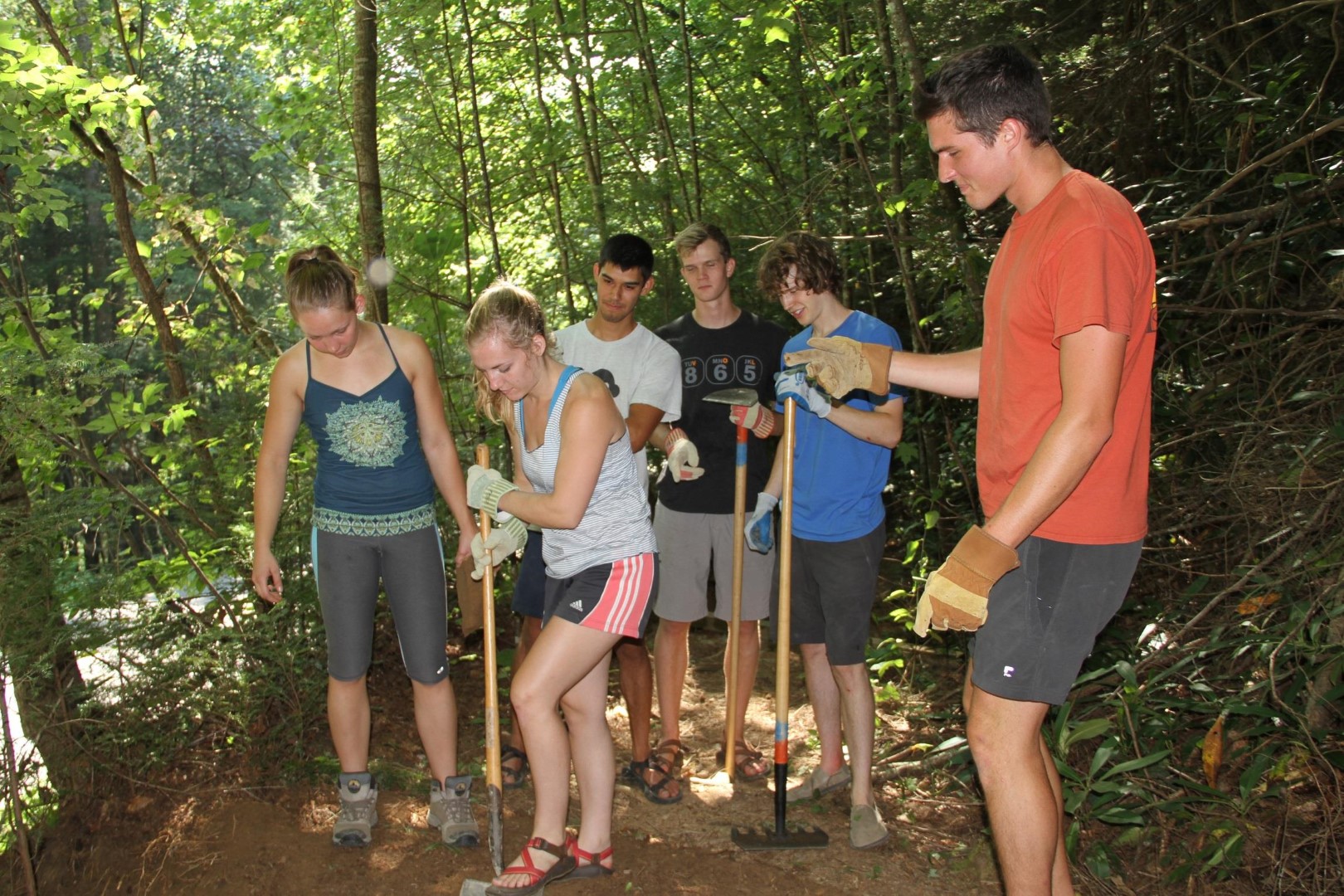 Volunteers are needed to improve and maintain climbing and approach areas at the Obed. National Park Service
WARTBURG — The Obed Wild and Scenic River will host the park’s annual Adopt-a-Crag event on Saturday, Sept. 11 in cooperation with the East Tennessee Climbers Coalition.
Volunteers are needed to help with a variety of projects, including general trail maintenance and litter pickup. Participants should meet at the Lilly Pad Hopyard Brewery at 9 a.m. to register and receive a project assignment. Carpooling is suggested, and volunteers should bring their own lunch, water, hand tools and gloves.
When the work is done, volunteers are invited to spend the day climbing, kayaking or hiking. The ETCC plans a volunteer appreciation dinner that evening at the Lilly Pad.
For more information, contact the Obed Wild and Scenic River at (423) 346-6294.
Falling trees accountable for very few deaths in Smokies, but they do happen
Written by Thomas FraserCITIZEN TIMES: Child killed by falling tree was a very rare twist of horrible fate
Karen Chavez of the Asheville Citizen Times wrote a great article on tree-related deaths in Great Smoky Mountains National Park and beyond following the death last week of a Georgia child killed by a falling tree as she was occupying a tent in Elkmont Campground.
She reports the death of the child was only the 11th tree-linked death in the national park’s history.
ELKMONT — A 9-year-old girl died early Wednesday after a tree fell on a tent she was occupying in Great Smoky Mountains National Park.
The unidentified child was among a group of people camping in Elkmont Campground when the red maple, 2 feet in diameter, fell shortly after midnight and crushed the girl in her tent, according to the National Park Service.
More...
Congo retreats from climate commitments to fuel its fossil energy sector
Written by Thomas FraserNYT: Why should we care when you built your world with fossil fuels?
The government of Congo is recruiting fossil-fuel extractors to suck oil from beneath tropical forest and bog ecosystems that rival the Amazon in their role as carbon sinks.
Opponents say it’s another step in knocking over the dominoes of climate renewal as Russia’s invasion of Ukraine continues to roil energy markets and threaten international commitments to addressing climate change.
HuffPost: More than 50 House Republicans want to repeal a century-old excise tax that bankrolls wildlife conservation
Written by Thomas FraserIn the latest “gun rights” lash-out from the GOP, legislation has been filed to abolish firearms taxes levied on gunmakers that fund wildlife conservation.
The Republican legislation is framed as a way to defend gun purchasers from odious taxation under the 2nd Amendment umbrella, but leading hunting and fishing interests said the proposal is misguided and misses the target by a wide mark.
The levy as currently written applies to gunmakers, not individual firearms purchasers.
Rare bipartisan legal effort under way for widespread wildlife protections
Written by Thomas FraserNYT: Recovering America’s Wildlife Act a big bipartisan push to preserve animal species
New York Times columnist Margaret Renkl noted recently that a precious opportunity has presented itself to strengthen wildlife-protection laws and add to environmental protections across the nation.
The Nashville-based journalist said the act, known as RAWA, “is poised to become the single most effective tool in combating biodiversity loss since the Endangered Species Act.” The resolution is carried in the House by Michigan Democrat Rep. Debbie Dingell.
“This bill provides funding for (1) the conservation or restoration of wildlife and plant species of greatest conservation need; (2) the wildlife conservation strategies of states, territories, or the District of Columbia; and (3) wildlife conservation education and recreation projects,” according to the U.S. Congress.

WBIR: UT got good bones
KNOXVILLE — The University of Tennessee boasts an incredible collection of animal skeletons — from hummingbirds to bison, according to a story from WBIR. It’s among the largest such assemblages in the country. (There are also skeletons at the Body Farm, but that’s a different story).
The skeletons are part of the UT Anthropology Department’s Vertebrate Osteology Collection.
“We have over 12,000 vertebrate specimens in our collections. So that’s 12,000 skeletons of individual animals,” Dr. Anneke Janzen, an assistant professor in UT’s Anthropology Department, told WBIR.