
Feedbag (218)
Children categories
Rangers probe suspected arson in Great Smokies
Written by Thomas FraserGATLINBURG — The National Park Service is investigating a possible arson fire off Laurel Creek Road near Crib Gap Trail. The fire was extinguished, but as part of the investigation, rangers are requesting the public’s help to find anyone who was in the area of Crib Gap Trail, Anthony Creek Trail or Lead Cove Trail Feb. 6 at about 6 p.m.
If you have information about vehicles or suspicious activity in the area around 6 p.m. on Tuesday, Feb. 6, please submit a tip. You don’t have to tell us who you are, but please tell us what you know. Rangers also ask that the person who originally reported the fire calls the number below as soon as possible.
CALL: 888-653-0009 or 865-436-1230
— National Park Service
Advance Knox plan gets policy committee approval; heads to other governing boards next
Written by Thomas FraserWATE: Knox County approves controversial Advance Knox plan in policy committee
KNOXVILLE — A Knox County growth plan advanced by Mayor Glenn Jacob’s administration was approved by the guiding committee behind Advance Knox.
Hellbender Press has reported and opined on the growth plan during its development. The plan was touted as a means of reducing sprawl and accompanying taxpayer-funded infrastructure.
Rural and suburban property owners remain dubious whether the proposed revamp of the original Knox County growth plan will control the countywide development encroaching on their land, according to reporting from WATE:
“Kevin Murphy doubles as an advisory committee member and resident of a rural area. He lives off of Washington Pike and said the area has already started morphing into a suburb.
“‘Today, there’s over 17,000 cars a day that pass by my farm. All this growth will increase that a lot and 17,000 cars a day is a pretty significant amount of noise, litter, light pollution, at all times of the hours, so the character is definitely changing,’ he said.”
The plan still needs to be approved by Knox County Commission, city of Knoxville and the town of Farragut.
Big South Fork NRRA celebrates 50th anniversary
Written by Thomas Fraser
New Year’s Day 2024: Mail Run bike ride
ONEIDA — Big South Fork National River & Recreation Area will commemorate its first 50 years with a year-long celebration in 2024. The park will recognize those who have played a pivotal role in making this special place what it is today.
Big South Fork prepares a year of honoring the past, celebrating today and planning for the future. “The story of Big South Fork is not finished. We are excited to engage with the community as we look forward to the next 50 years,” said Superintendent Niki Stephanie Nicholas.
As the new year approaches, there is a lot in store, from the installation of dozens of brand-new interpretive waysides and information boards — found at trailheads, parking lots and other points of interest throughout the park — to a completely overhauled official park map and guide, special events, ranger-led programs and incredible social media content, just to name a few.
Big South Fork’s 50th anniversary activities start with a celebration at Bandy Creek Visitor Center on Monday, Jan. 1, at 10 a.m., where mountain bikers are invited to ride the annual “Mail Run” event.
This ride is traditionally called the Mail Run because it occurs every year, no matter the weather. Just remember to BYOB (Bring Your Own Bike). The Mail Run consists of a choice of rides from 8-35 miles so bikers can pick the group ride of a length they are most comfortable with. Hot chocolate and coffee will be available at Bandy Creek Visitor Center before the rides start.
ORNL wants to leave watercraft carbon emissions in its wake
Written by Oak Ridge National Laboratory This Caterpillar in-line 6-cylinder marine diesel engine will be the subject of research and development for efficient, more climate-friendly marine propulsion with methanol fuel. Genevieve Martin, ORNL/U.S. Dept. of Energy
OAK RIDGE — The Department of Energy’s Oak Ridge National Laboratory and Caterpillar Inc. have entered into a cooperative research and development agreement to investigate methanol as an alternative fuel source for four-stroke internal combustion marine engines. The collaboration supports efforts to decarbonize the marine industry, a hard-to-electrify transportation sector.
As the U.S. continues to seek ways to reduce environmentally harmful greenhouse gas emissions, methanol is an attractive fuel alternative to diesel because it reduces carbon emissions. Methanol also reduces emissions of nitrogen oxides and sulfur oxides. In addition, methanol’s relatively high energy density makes it easier to store on marine vessels than gaseous fuels meaning it can be more easily integrated into overall existing engine design and operation.
Greener solution powers new method for lithium-ion battery recycling
Written by Thomas Fraser ORNL researchers Lu Yu and Yaocai Bai examine vials that contain a chemical solution that causes the cobalt and lithium to separate from a spent battery, followed by a second stage when cobalt precipitates in the bottom. Carlos Jones/ORNL/DOE
OAK RIDGE — Used lithium-ion batteries from cell phones, laptops and a growing number of electric vehicles are piling up, but options for recycling them remain limited mostly to burning or chemically dissolving shredded batteries. The current state-of-the-art methods can pose environmental challenges and be difficult to make economical at the industrial scale.
The conventional process recovers few of the battery materials and relies on caustic, inorganic acids and hazardous chemicals that may introduce impurities. It also requires complicated separation and precipitation to recover the critical metals. However, recovering metals such as cobalt and lithium could reduce both pollution and reliance on foreign sources and choked supply chains.
This research is funded as a project of the Advanced Battery Recycling Consortium, or ReCell, a program of the Vehicle Technologies Office within DOE’s Office of Energy Efficiency and Renewable Energy. Lu Yu and Yaocai Bai and researchers Rachid Essehli and Anuj Bisht contributed to the study, which utilized the DOE’s Center for Nanophase Materials Science at ORNL.
— Oak Ridge National Laboratory
TDEC releases money to help rubber meet the road
Written by Thomas Fraser
KNOXVILLE — The Tennessee Department of Environment and Conservation granted $350,197 to the University of Tennessee from the Tire Environmental Act Program.
“We are seeing great advances in repurposing tires for environmental benefits,” said TDEC Deputy Commissioner Greg Young. ”Programs like this not only help clean up sites of used tires, they involve innovative new uses for them. We congratulate UT-Knoxville on this project.”
UTK is partnering with the Tennessee Department of Transportation (TDOT) to install a series of pavement test sections using the technologies developed from this project. Benefits of including rubber in asphalt pavement mixes include improved skid resistance, cracking resistance, and noise reduction.
The purpose of the Tire Environmental Act Program is to select and fund projects that best result in beneficial uses for waste tires. Projects must qualify for one of three categories: tire processing/recycling, tire-derived material use, or research and development. The program provides grant funding to eligible entities, including local governments, non-profit organizations, higher education institutions, K-12 schools and for-profit businesses.
Tennessee established the Tire Environmental Fund in 2015. Upon the first retail sale of a new motor vehicle to be titled and registered in Tennessee, a flat fee based on the number of a vehicle’s wheels is assessed. The fee goes into the fund, which is used for projects creating or supporting beneficial end uses for waste tires.
Since 2015, grantees have been awarded almost $6.8 million, and approximately 5.5 million tires or nearly 58,000 tons of scrap tires have been diverted from landfills. The tires are repurposed for use in rubberized asphalt, tire-derived aggregate, tire-derived fuel, granulated rubber porous flexible pavement, and other beneficial end uses that result in tires being diverted from landfills for a higher and better use.
— Tennessee Department of Environment and Conservation
ORNL separates rare earth from the chaff
Written by Oak Ridge National Laboratory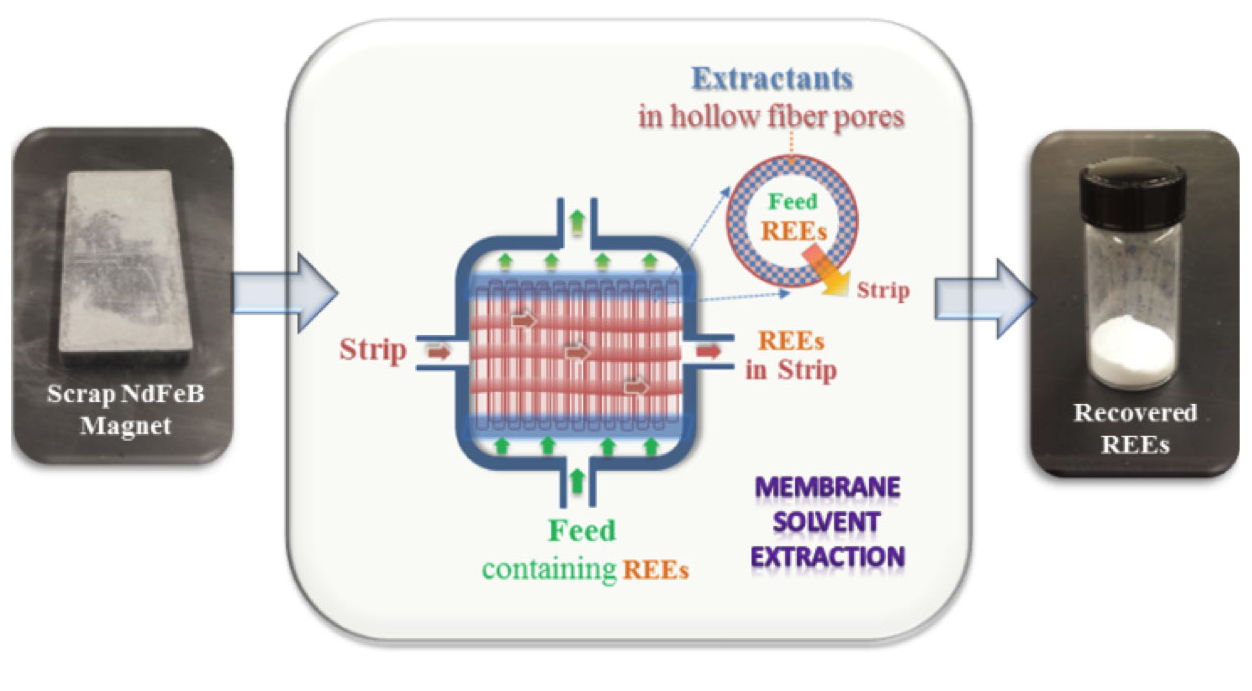 Membrane solvent extraction schematic. ORNL
OAK RIDGE — Caldera Holding, the owner and developer of Missouri’s Pea Ridge iron mine, has entered a nonexclusive research and development licensing agreement with Oak Ridge National Laboratory to apply a membrane solvent extraction technique, or MSX, developed by ORNL researchers to process mined ores. MSX provides a scalable, efficient way to separate rare earth elements, or REEs, from mixed mineral ores.
The MSX technology was pioneered at ORNL by researchers in the Department of Energy’s Critical Materials Innovation Hub, or CMI, led by Ames National Laboratory. The inventors, Ramesh Bhave and Syed Islam of ORNL’s Chemical Sciences Division are named in 26 inventions and five active licenses related to the recovery of REEs.
Grayson Subaru Selects Ijams Nature Center as Hometown Charity for 2023 Subaru Share the Love Event
Written by Cindy Hassil Ijams Nature Preschool students were the first to explore the Ijams Nature Playscape at Grayson Subaru Preserve before it opened to the public in May 2022. Customers who purchase or lease a new Subaru from Grayson Subaru Nov. 6, 2023-Jan. 2, 2024, can choose to have Subaru of America, Inc., donate $250 to Ijams as part of the 2023 Subaru Share the Love Event. Donations will be used to expand this natural play area as well as improve the Mead’s Quarry swim area. Cindy Hassil.
Starting in mid-November, getting a new car from Grayson Subaru could mean new places to play and learn at Ijams Nature Center.
Grayson Subaru has chosen the nonprofit nature center as its hometown charity for Subaru of America, Inc.’s annual Subaru Share the Love Event.
Enviva’s financial problems shed light on biomass energy flaws
Written by Southern Environmental Law Center The Impacted Communities Against Wood Pellet Coalition (ICAWP) organized the protest and says the company has been ignoring the concerns of impacted communities while receiving millions of dollars in subsidies and tax breaks from the state. ICAWP
This week Enviva, which is the world’s largest wood pellet manufacturer, saw its stock price fall by more than 90 percent from its height earlier this year following a grim financial report from the company. The company’s money problems show the massive flaws with the biomass energy industry and are due in part to the company being held accountable for its polluting pellet plants.
Enviva operates pellet plants across the South. These dirty facilities release huge amounts of air pollution, dust and fine particulates that can cause asthma and respiratory illnesses in nearby communities. The hazardous plants are often times sited near communities of color that are already overburdened with industrial pollution.
Enviva’s current financial crisis is due in part to the company being forced to internalize the environmental costs of its dirty operations, rather than pushing them off onto nearby communities. SELC, along with community partners across the region, have scored major victories against Enviva and other pellet companies, forcing them to install pollution controls and better protect people living nearby.
“Enviva’s wood pellet plants have caused long-lasting damage to communities across the South. The company’s financial problems are partially caused by communities standing up and pushing back on this dirty industry,” said Heather Hillaker, Senior Attorney for SELC.
Intergenerational Playspace open in North Knox
Written by Legacy Parks Foundation
Legacy Parks Foundation cut the ribbon on the Intergenerational Playspace at Beverly Park in North Knox County. It is the first park in the region to be purposefully designed to create active interactions between multiple generations, especially children and seniors.
“This park was made possible by our many partners that supported and funded the project,” said Carol Evans, Legacy Parks’ executive director.
Legacy Parks was awarded a $150,000 two-phase grant from the Trinity Health Foundation to research, design and create the Playspace. Additional grants and construction services provided by Knox County made the park possible
Construction continues on Lakeview Drive in GSMNP
Written by Thomas Fraser
Road will reopen with single-lane closures on Nov. 16 at 12 p.m.
GATLINBURG— Great Smoky Mountains National Park continues to rehabilitate Lakeview Drive in North Carolina through Great American Outdoor Act funding. The NPS will open Lakeview Drive to vehicles on Nov. 16 at 12 p.m., but visitors shouldplan for temporary single-lane closures andperiodic closures of some parking areas as construction is completed.
Construction crews will continue to rehabilitate parking areas, guardrails, headwalls and more over the next few weeks. Crews will complete the road rehabilitation in the spring when they place the final layer of asphalt that will provide for a smoother ride.
Hikers and visitors will be able to access the Noland Creek Trail, Lakeshore Trail, Goldmine Loop Trail, Benton MacKaye Trail, or Lakeview Drive Tunnel from the road, but may not be able to park at the closest parking lot to the trailhead. Visitors should expect to see machinery and equipment in the area until the project is complete.
Tennessee developing a plan to reduce polution
Written by Thomas Fraser
Tennessee wants to prioritize a developing plan to reduce pollution causing climate warming and wants to hear from residents. A survey was created for residents to share what they wanted to see in a statewide climate pollution reduction plan. The survey closed on Nov. 15.
This planning process is being led by the Tennessee Department of Environment and Conservation (TDEC) and is part of the Tennessee Volunteer Emission Reduction Strategy (TVERS), an emission reduction plan currently being developed by TDEC with support from various partners. This plan is funded through the U.S. Environmental Protection Agency’s (EPA) Climate Pollution Reduction Grant (CPRG) program, which was established in the Inflation Reduction Act of 2022 (IRA).

Rhea County — Watts Bar Reservoir created in 1942, has remained a consistent bass fishery according to data collected over the past decades. Reservoir biologists are hopeful that a recent catch is reflective of Florida largemouth bass stocking efforts started in 2015.
Randy Miller of Spring City caught an 11.22-pound largemouth bass on the reservoir and graciously shared the photo with reservoir biologist Mike Jolley. Jolley, an employee with over three decades of professional experience, grew up on the lake and has intimate knowledge of its waters. Jolley shared, “We routinely evaluate our fisheries in reservoirs, including Watts Bar, to assess overall health of population dynamics. Some anglers have questioned the status of the bass fishery in this lake. I’m happy to share that Watts Bar has remained a consistent fishery based on long-term, routine data collection.”
Great Smoky Mountains National Park implements backcountry fire restrictions
Written by Rachel Kovac
GATLINBURG — Due to dry conditions and the increased risk for wildfires, the National Park Service (NPS) is temporarily banning backcountry campfires in Great Smoky Mountains National Park effective immediately. The fire restriction will be in effect until further notice.
“We are experiencing dry conditions throughout the park, in both North Carolina and Tennessee,” said Deputy Superintendent Alan Sumeriski. “With dry conditions persisting over the next week, it is imperative that we reduce the risk of human-caused wildfires.”
The fire restriction only applies to campers using the park’s 100 backcountry sites and shelters. It does not affect campers at the park’s front country (developed) campgrounds or picnickers using fire grills at picnic areas. Fires in developed areas must always be confined to designated fire rings and grills. The NPS asks front country campers to reduce the risk of wildfires by extinguishing fires completely until ashes are cool to the touch. Backpackers may use stoves with compressed gas canisters.
The NPS is working with multiple area agencies in response to current and predicted weather and fuel conditions. Visitors should use extra caution recreating on public lands including national parks and national forests in North Carolina and Tennessee when fire danger is increased.
Obed WSR announces restrictions on backcountry fires
Written by Rachel Kovac Obed Wild & Scenic River paddler. NPS
WARTBURG — Obed Wild & Scenic River officials announced a temporary ban on campfires in the park’s backcountry effective immediately. Due to abnormally dry weather conditions and the amount of fresh leaf litter on the ground, the potential for escaped fires to occur in the backcountry has greatly increased. The fire restriction will be in effect until further notice.
The fire ban does not affect campers at Rock Creek Campground or picnickers using fire grills at picnic areas. Fires at developed areas must be confined to designated fire rings and grills. All visitors are asked to take certain precautions to help reduce the risk of wildfires. This includesextinguishing front country fires by mixing water with embers in fire rings and grills. Use of backpacking stoves is still permitted at backcountry campsites.
“With the current drought conditions, it is imperative that we mitigate the risk of human-caused wildfires during this period of high fire danger,” said Superintendent Niki Stephanie Nicholas.
“The park has not banned backcountry campfires since November 2016, but these unusually dry conditions warrant the restriction.”
More information about backcountry trip planning, please visit the park visitor center or call 423-346-6294.
More...
‘Save Money, Save Energy’ Expo — at Ijams this Sunday
Written by Thomas Fraser Explore how to reduce your monthly power bill and increase the health and comfort of your home.
Federal and local funding opportunities available at all income levels
KNOXVILLE — As the weather turns colder, many Knoxvillians start to worry about home heating bills. Fortunately, energy efficiency incentives and funding programs are available to Knoxvillians of all income levels through federal tax credits and rebates. Free local funding is available for qualifying customers of KUB through the “Home Uplift” program. Many Knoxvillians are unaware of these opportunities or unsure of how to access the funding programs.
Family-friendly Home Energy Expo
The local organizations that cooperate with small local businesses in the Save Money, Save Energy program and the expo and workshop at Ijams are the Southern Alliance for Clean Energy (SACE), Knoxville Utilities Board (KUB), Socially Equal Energy Efficient Development (SEEED), Sierra Club – Harvey Broome Group, Three3 (pronounced three cube) and Tennessee Interfaith Power and Light (TIPL).
Home Energy Expo at Ijams Nature Center, 2915 Island Home Ave, Knoxville, TN 37920 — Sunday, Nov. 5, 2023 from 1 p.m. to 4 p.m.
Save Money, Save Energy workshop starts at 2:30 p.m. (RSVP recommended to secure a seat)
- save money, save energy workshop
- home energy expo
- southern alliance for clean energy
- ijams nature center
- knoxville utilities board
- socially equal energy efficient development
- sace
- kub
- seeed
- harvey broome group of the sierra club
- three3
- tennessee interfaith power and light
- tipl
- home health
- home comfort
- energy efficiency
- home uplift
- tennessee valley authority
- tva
- electric vehicle expo
- solar power
- hvac
- solarpowered dollhouse
- utility bill
Arbor Day Bonus: $4.3 mil in FED grants means more Knoxville trees
Written by Thomas FraserPlease join Mayor Kincannon, City Council members, Trees Knoxville and University of Tennessee leaders, and others at the City Tree Board’s Arbor Day tree-planting at 2 p.m. Monday, Nov. 6, at Harriet Tubman Park, 300 Harriet Tubman St.
Thanks to two federal grants totaling $4.3 million, tree lovers hoping to expand Knoxville’s canopy — especially in neighborhoods needing it the most — are especially joyful this Arbor Day.
The federal government has awarded $1.7 million to Trees Knoxville, a City nonprofit partner, to plant and maintain 7,500 trees along streets, in parks, at schools, in public housing communities, in historic African-American cemeteries and elsewhere.
The University of Tennessee, Knoxville, was awarded another $2.6 million to increase tree canopy coverage, reduce stormwater runoff, mitigate extreme heat and bring ecosystem services to underserved communities in East Knoxville.
Both tree grants were funded through the federal Inflation Reduction Act, touted as the biggest climate investment in U.S. history.
“The investments made possible by these federal grants will be transformative,” Mayor Indya Kincannon said. “We’re going to reverse the slow decline of tree canopy, and in fact prioritizing the greening up of areas that we know are the most in need of additional plantings.”
No one trashes Tennessee — It’s No Trash November
Written by Thomas Fraser
It’s time for the 3rd annual No Trash November
This year Tennessee is out to make history again. All volunteer groups who regularly pick up litter on Tennessee roadways will rally together and host a cleanup event in November — cleaning up Tennessee right before friends and families visit for the holidays.
Join a community of Tennesseans carving out gardens to attract, feed and nurture pollinating wildlife
Written by Thomas Fraser These signs will show your friends and neighbors that your wildflower garden supports pollinators and hopefully get them excited about starting a pollinator garden too! Our original signs are made from embossed, recycled aluminum and measure 8 x 12 inches. They are available for a donation of $25 each and can be shipped directly to you. Tennessee Environmental Council
Through Generate Some Buzz, the Tennessee Environmental Council aims to engage hundreds of Tennesseans in establishing new pollinator habitats statewide. All gardens, both big and small are welcome and by participating in this program, you are joining a vibrant community of Tennesseans committed to protecting our pollinators, one plot at a time.
Populations of many pollinator species like bees, butterflies, moths, beetles and hummingbirds have been negatively impacted by agricultural practices such as using synthetic pesticides, disease and habitat loss. These creatures are experiencing a drastically different world compared to just a few decades ago.
Native pollinators depend on native plants to provide habitat and food, and plants need pollinators to help them reproduce. In fact, pollinators assist in the reproduction of 75 percent of flowering plants worldwide. Turning manicured lawns that provide little to nothing for pollinators into havens full of native flowers and wild grasses, we will effectively "Generate Some Buzz" and bring back these essential workers full force.
